Voice broadcast (voice blast)
A pre-recorded message played to a list of numbers. It talks; it does not listen. Some broadcasts end with "press 1 if interested". Used for announcements, reminders and offers to large lists.
All three put a machine on the phone, but they do very different jobs. A voice broadcast plays a message. An IVR asks people to press 1 or 2. An AI calling agent has a conversation, in Hindi, Hinglish or 7 more Indian languages. Here is how they compare, what each sounds like, and when each one is the right choice.
A pre-recorded message played to a list of numbers. It talks; it does not listen. Some broadcasts end with "press 1 if interested". Used for announcements, reminders and offers to large lists.
A menu that answers or makes calls and asks callers to press keys: "Sales ke liye 1 dabaiye". It routes calls and collects digits, such as an order number. It cannot understand an open question.
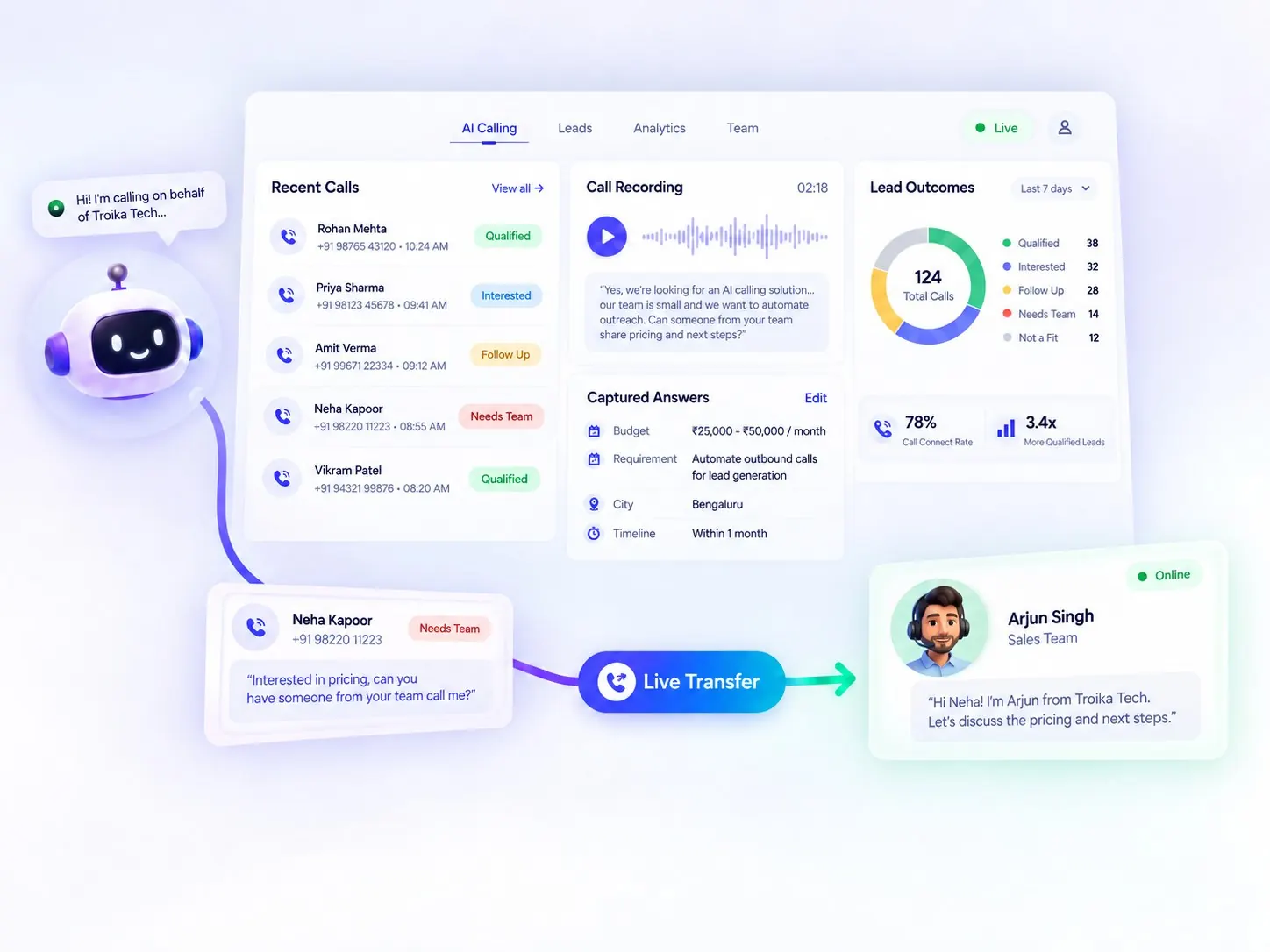
Software that listens, understands and replies in natural speech. It asks questions, handles "abhi busy hoon" or "price kya hai", books visits and transfers interested callers to your team. How AI voice agents work.
| AI calling agent | IVR | Voice broadcast | |
|---|---|---|---|
| How the caller responds | Speaks naturally | Presses keys | Listens only (or presses 1) |
| Understands open questions | Yes | No | No |
| Hindi, Hinglish, regional languages | 9 languages, switches mid-call | One recording per language | One recording per language |
| Handles objections ("abhi busy hoon") | Yes, replies and offers a callback | No | No |
| Qualifies leads | Asks your questions and records answers | Digits only | At most a keypress |
| Books visits or callbacks | Yes, on the call | Limited | No |
| Live transfer to your team | Yes, with context | Yes, by menu choice | Rarely |
| What you learn after the call | Recording, transcript, summary, outcome | Keypress log | Delivered / answered |
| Feels like | A conversation | A menu | An announcement |
| Best for | Leads, follow-ups, qualification, bookings | Routing inbound calls | One-way announcements to big lists |
A real estate developer wants to invite past enquiries to a site visit this weekend.
"Namaste! Sunrise Homes mein is weekend special offer. Site visit ke liye abhi call karein. Dhanyavaad."
The message plays. The customer cannot ask anything. Nothing is booked.
"Site visit book karne ke liye 1 dabaiye. Sales team se baat karne ke liye 2 dabaiye."
If the customer presses 1, a slot may be booked. Questions like "parking hai kya?" have nowhere to go.
AI: "Namaste Rahul ji, Sunrise Homes se bol rahi hoon. Aapne 2BHK ke baare mein poocha tha. Is weekend site visit ke liye Saturday 11 baje ya Sunday 4 baje theek rahega?"
Customer: "Parking hai kya?"
AI: "Haan, har flat ke saath covered parking hai. Sunday 4 baje book kar doon?"
A question is answered, a visit is booked and the call is recorded and summarised.
Qualifies a project enquiry and captures budget, in Hindi.
Offers a site visit and confirms the slot.
Checks eligibility and interest on an admissions call.
Explains a health policy renewal and records the reply.
Hands a warm buyer straight to the sales team, mid-call.
Answers a finance enquiry and logs the request.
"Press 1 for sales, 2 for support" works when callers already know what they want and you only need to route them.
A holiday closure, a school notice or a schedule change needs no conversation. A broadcast is enough.
Where every caller must hear exactly the same words and choose from fixed options, an IVR menu is predictable.
Use AI calling when the call has to ask questions, handle objections, qualify a lead, book something or decide who to transfer. That is where menus and recordings lose people.
"Haan, budget 50 lakh tak hai" is one sentence in two languages. An IVR cannot take that as an answer. An AI agent understands it and switches language when the caller does.
Many callers, including older customers, would rather say what they want than listen to a list of options and press keys.
"Sunday 4 baje" takes a second to say. Navigating a menu for the same booking takes several steps.
A robocall or voice blast plays a recording and does not listen. People hang up because they cannot respond.
It introduces the business, asks permission, answers questions and stops when asked. When someone says "mujhe call mat karo", the call ends politely and the number goes to your opt-out list.
Both work best on people who enquired or are your customers. AI calling is not a way to call strangers at scale; it is a way to talk to every lead properly.
Start with the call that loses the most leads today, for example enquiry follow-up or site visit invitations.
Short lines, one question at a time, a clear next step. Our free script generator gives you a first draft.
Run AI calling on part of the list and compare pickups, qualified leads and bookings with your current method.
Move more call types to AI calling and keep IVR or broadcast where they still fit.
Send the announcement to everyone, then let an AI agent call the people who pressed 1 or showed interest, and qualify them properly.
Keep your inbound menu for routing and use an AI agent for outbound follow-ups and for questions the menu cannot answer.
The AI agent handles the first conversation and transfers hot leads, with a recording and summary, to the people who close.
A broadcast or IVR call usually costs less per call, but if nobody can ask a question or book on the call, the cost per qualified lead can be high.
A one-time setup plus prepaid credits billed per second of call time, so short calls cost seconds, not minutes. How AI calling pricing works.
AI calling is used legally in India when it follows the same rules as any business calling: TRAI's telemarketing regulations, respect for the DND (Do Not Disturb) registry, permitted calling hours and a clear way to opt out.
This is general guidance, not legal advice. Compliance depends on your campaign intent and your data.
“The biggest advantage is that it can call 1,000, 2,000, or even 4,000 people in a single day. We have been using this system for the last 3-4 days, and we have already received around 10 to 15 positive leads.”
“The AI Calling and WhatsApp Messaging services have been effective and useful for our requirements to generate hot leads from bulk data. Their assistance and prompt responses made the overall experience smooth.”
“The AI calling agent is performing well, and the automated marketing outreach through the AI bot is being executed effectively. The system has helped in customer engagement.”
A voice broadcast plays a recorded message. An IVR plays a menu and responds to keypresses. An AI calling agent listens, understands natural speech, answers questions, qualifies leads, books visits and transfers interested callers to your team.
No. A robocall plays a recording and does not listen. An AI calling agent holds a two-way conversation, answers questions and ends the call politely when asked.
For simple routing of inbound calls, one-way announcements, and fixed flows where every caller must hear exactly the same words.
Troika's AI agent speaks English, Hindi, Marathi, Gujarati, Tamil, Telugu, Kannada, Bengali and Malayalam, and switches when the caller mixes languages.
Yes. With an AI calling agent callers answer in their own words, for example "Sunday 4 baje", instead of navigating a menu.
Commercial calls in India follow TRAI's telemarketing rules and customers' DND preferences however the call is made. Call people who enquired or are your customers, within business hours, and honour every opt-out. This is general guidance, not legal advice.
Yes. Many businesses keep the IVR for inbound routing and use AI calling for outbound follow-ups and conversations the menu cannot handle.
Start with one call type, write a short script, run a pilot on part of your list and compare qualified leads and bookings before you scale.
Enter your number and we will set up a live AI demo call for you. Hear the voice, interrupt it, ask it questions, in Hindi or English.