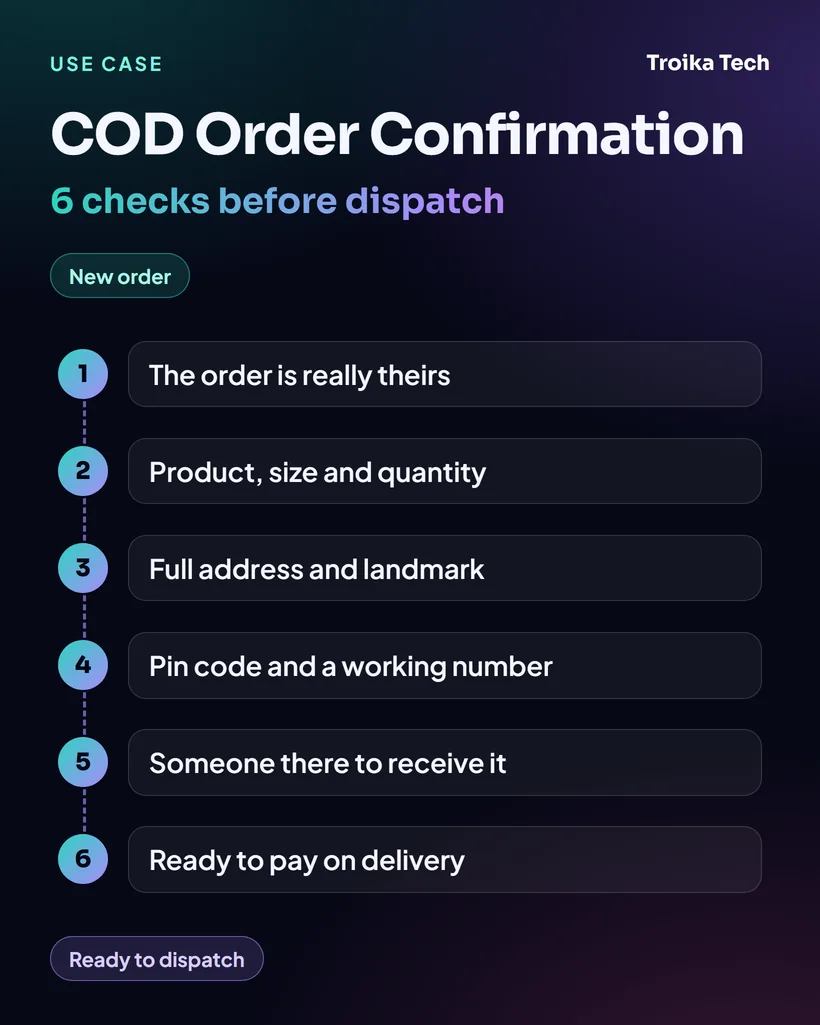
1. The order is really theirs
Numbers get typed wrongly, and sometimes someone else places an order using a friend's number. Asking this first saves the rest of the call.
"Did you place this order yourself?"
COD order confirmation is a short phone call made before a cash-on-delivery order is shipped, to check that the customer really placed it and will accept it. An AI voice agent makes these calls in the customer's language and flags doubtful orders for your team, before you spend on shipping. This guide gives you the 6 checks, a ready script and a calculator for your own numbers.
When a cash-on-delivery parcel is refused or cannot be delivered, it travels back to you. This is called RTO, or return to origin, and you usually pay for the trip out, the trip back and the packing, with no sale at the end. Some of these orders can be spotted before they leave. A short call finds out whether the buyer meant the order, whether the address works and whether someone will accept it. A typical call sounds like this:
Enter your number and we will set up a live AI demo call for you. Hear the voice, interrupt it, ask it questions, in Hindi or English.
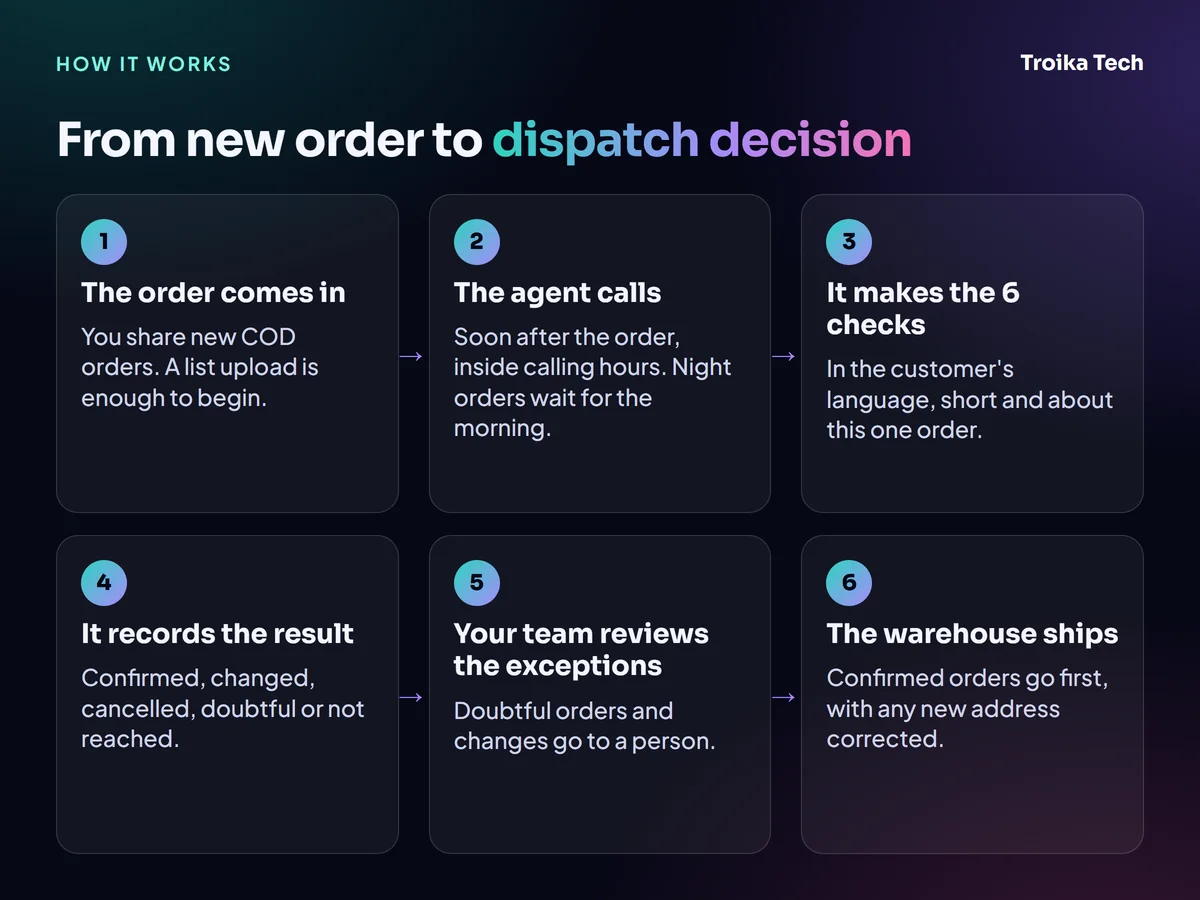
The call sits between the order and the warehouse, and you keep the final say on what ships.
Each check has a reason. Together they usually take a minute or two, and any of them can be dropped if it does not matter for your products.
Numbers get typed wrongly, and sometimes someone else places an order using a friend's number. Asking this first saves the rest of the call.
"Did you place this order yourself?"
A wrong size or an accidental double order often turns into a refusal at the door. Reading it back catches these while they can still be fixed.
"That is one pair in size 9. Is that right?"
A missing flat number or lane is a common reason for a failed delivery. A landmark gives the courier one more way to find the place.
"Is there a landmark near your home?"
A wrong pin code can send a parcel to the wrong hub. A second number helps if the first one is switched off on delivery day.
"Is there another number the courier can call?"
Buyers who work all day can miss every attempt. Knowing the best time, or who else can take the parcel, helps your team and the courier.
"Will someone be home during the day?"
The agent states the amount due, so that it is no surprise at the door. Hesitation here is the most useful signal you will get.
"The amount to pay on delivery is [amount]. Is that fine?"
Calling every order is simplest. If you would rather begin with part of your orders, start where a return hurts most or is most likely.
One returned parcel of a costly product can cancel out the margin on many good ones.
You know nothing about them yet. People who have accepted parcels from you before can wait.
Your own courier reports show where parcels come back most. Call these areas first.
Very short addresses, or those with no flat or lane, are easy to spot in the order list.
Impulse orders from new campaigns may need a call more than orders from people who searched for you by name.
Several units of a product most people buy once can be a typing slip, a reseller or a mischievous order.
Each has a place. Many stores send a message first and call those who do not reply, or call only higher-value orders.
| AI call | SMS or chat message | Your own staff | Press-1 IVR call | |
|---|---|---|---|---|
| Reaches people who ignore messages | Yes | No | Yes | Yes |
| Can fix an address on the spot | Yes, it notes the new details | Only if the buyer types it | Yes | No |
| Picks up doubt in the answer | Flags it for your team | No | Yes | No: only key presses |
| Speaks the buyer's language | 9 Indian languages | One per template | Whoever is on shift | One per recording |
| Copes with a sudden rise in orders | Many calls in parallel | Yes | Only with more people | Yes |
| Leaves a record | Recording, transcript, outcome | Reply, if any | Depends on the team | Key pressed |
| Best for | Orders worth a real check | Low-value orders | Very high-value or tricky orders | A simple yes or no |
Put in your own numbers to see what returned parcels cost each month, and what a small fall would be worth. Enter the fall you think is realistic for your store.
The starting values are samples, so replace them with your own. This is your arithmetic, not a promise of results. Nothing is sent or saved.
Change the names and details, and keep the same order. The first question matters most, so ask it early and leave offers out of this call.
एजेंट: नमस्ते [नाम] जी, मैं [स्टोर] से बोल रही हूँ। आपने कल [प्रोडक्ट] का ऑर्डर किया था, कैश ऑन डिलीवरी पर। क्या यह ऑर्डर आपका ही है?
ग्राहक: जी, मेरा ही है।
एजेंट: धन्यवाद। पता है: [पता]। क्या पास का कोई लैंडमार्क बता सकते हैं?
ग्राहक: [लैंडमार्क] के पास।
एजेंट: डिलीवरी पर [राशि] देने होंगे। क्या उस समय घर पर कोई रहेगा?
ग्राहक: जी, शाम को रहेगा।
एजेंट: धन्यवाद, मैंने नोट कर लिया है। आपका ऑर्डर जल्द भेजा जाएगा।
Agent: Namaste [Name] ji, main [Store] se bol rahi hoon. Aapne kal [Product] order kiya tha, cash on delivery par. Kya yeh order aapka hi hai?
Customer: Ji, mera hi hai.
Agent: Dhanyavaad. Pata hai: [Address]. Kya paas ka koi landmark bata sakte hain?
Customer: [Landmark] ke paas.
Agent: Delivery par [amount] dene honge. Kya us samay ghar par koi rahega?
Customer: Ji, shaam ko rahega.
Agent: Dhanyavaad, maine note kar liya hai. Aapka order jaldi bheja jayega.
Agent: Hello [Name], this is [Store]. You ordered [Product] yesterday, cash on delivery. Is this your order?
Customer: Yes, it is mine.
Agent: Thank you. The address is [Address]. Could you give a nearby landmark?
Customer: Near [Landmark].
Agent: The amount to pay on delivery is [amount]. Will someone be home to receive it?
Customer: Yes, in the evening.
Agent: Thank you, I have noted that. Your order will be sent soon.
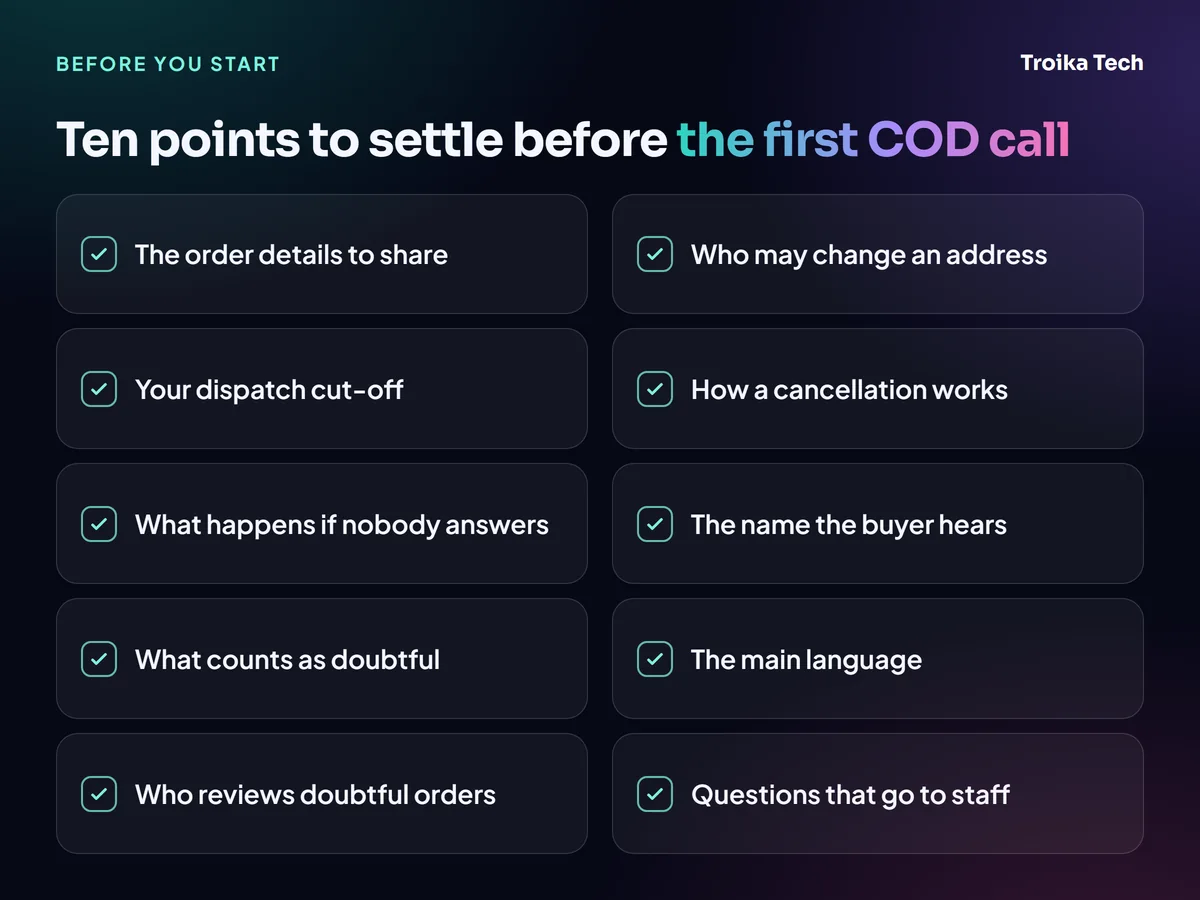
Most of these are decisions only you can make. Writing them down first keeps the agent and your warehouse working to the same rules.
Do not rely on anyone's percentage, ours included. Your own numbers will tell you, if you test it fairly.
In the same weeks, call some orders and leave a similar set uncalled. Comparing this month with last month can mislead, because sales and seasons change.
Count an order only when it has been delivered or returned. Early numbers look better than they are, because returns take time to come back.
A call can also lose a good order if it makes someone think twice. Compare delivered orders per hundred placed, not only the return rate.
Reasons from the calls show which ads, products and pin codes bring the most doubtful orders, which is often as useful as the calls themselves.
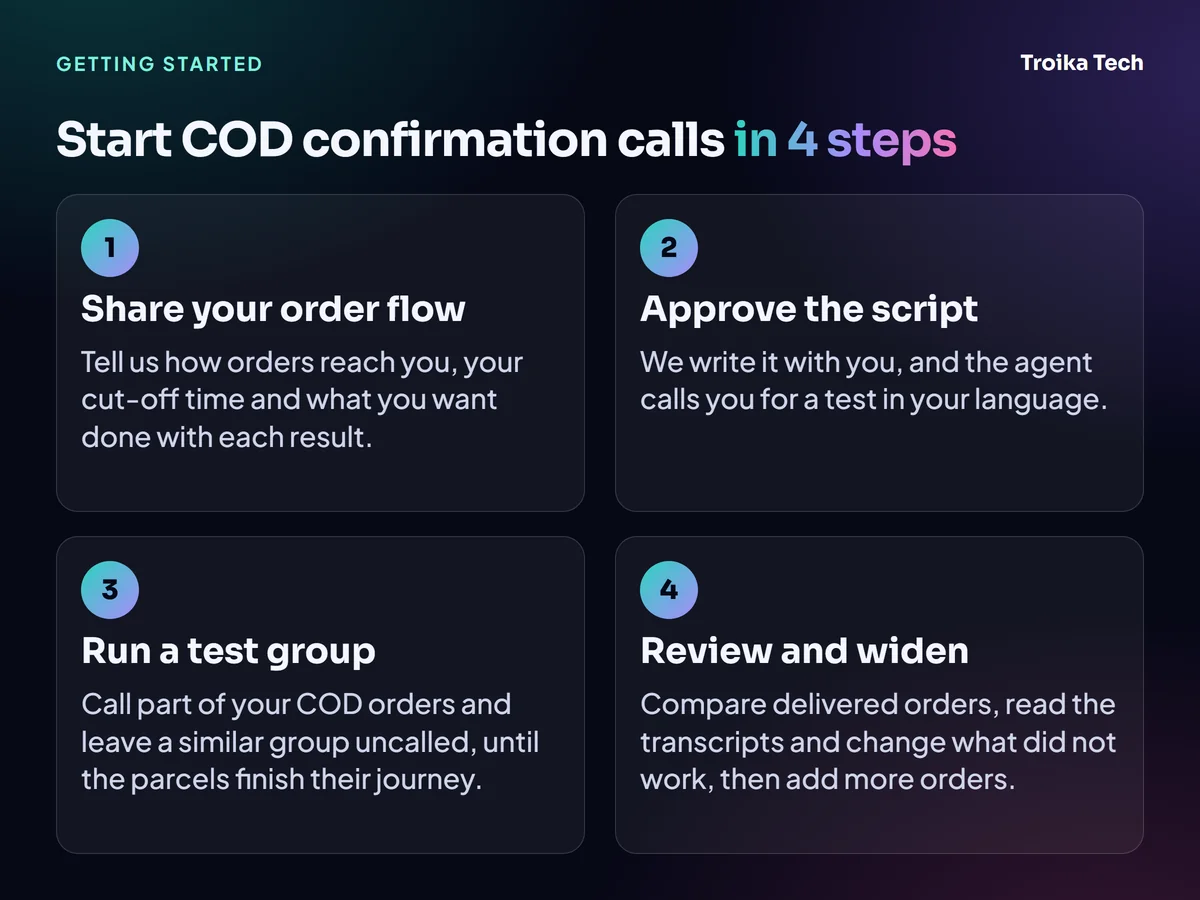
Start with part of your orders so that you can compare. Most campaigns go live in 24 hours to 7 days.
Tell us how orders reach you, your cut-off time and what you want done with each result.
We write it with you, and the agent calls you for a test in your language.
Call part of your COD orders and leave a similar group uncalled, until the parcels finish their journey.
Compare delivered orders, read the transcripts and change what did not work, then add more orders.
Fix: a call after the parcel is packed or shipped leaves little you can change. Match your calling to the dispatch cut-off.
Fix: keep it about this order. An offer turns a useful check into a sales call and makes people less likely to pick up the next one.
Fix: plenty of real buyers miss one call. Try again at another time before you hold an order.
Fix: the tone should be "helping your parcel reach you", not "proving you are genuine". Good buyers should feel looked after.
Fix: if one ad or pin code keeps failing the checks, change it. Calling alone will not fix a bad source of orders.
जब कैश ऑन डिलीवरी का पार्सल वापस आता है, तो शिपिंग और पैकिंग का ख़र्च आपको उठाना पड़ता है और बिक्री भी नहीं होती। इसलिए पार्सल भेजने से पहले एक छोटी-सी कॉल की जाती है, जिसमें पूछा जाता है कि ऑर्डर ग्राहक का ही है या नहीं, पता सही है या नहीं और डिलीवरी के समय कोई घर पर रहेगा या नहीं।
एआई एजेंट यह कॉल ग्राहक की भाषा में करता है और जिन ऑर्डर पर शक हो, उन्हें आपकी टीम को बता देता है। आख़िरी फ़ैसला आपका ही रहता है। शुरुआत कुछ ऑर्डर से कीजिए और देखिए कि कॉल किए गए ऑर्डर में से कितने डिलीवर हुए।
It is a check made before a cash-on-delivery order ships, to confirm that the customer placed it, that the address works and that someone will accept and pay for it. It can be done by call, message or IVR.
It can help, because it catches wrong addresses, unwanted orders and people who will not be available. It will not remove every return. Test it on your own orders with a called and an uncalled group.
As soon as you can after the order and before your dispatch cut-off, inside calling hours of generally 9 AM to 8 PM. Orders placed at night wait for the morning.
You decide how many tries to make and at what times. After that, you choose whether such orders ship or wait, and our team can set this up either way.
A call reaches people who ignore messages, and it can fix an address or pick up doubt. A message costs less effort for low-value orders. Many stores use both.
It notes the new address or landmark and passes it to your team, so that your system and courier can be updated. Direct updates can be looked at after a feasibility check.
It records that the customer wants to cancel and passes this on, so your team can stop the order. You decide what it should say first.
You can begin with a list of orders in a sheet. A direct link to your store or order system is possible after a feasibility check.
English, Hindi, Marathi, Gujarati, Tamil, Telugu, Kannada, Bengali and Malayalam. Each campaign has a main language, and the agent follows a customer who switches.
Many calls can run in parallel, so a sale day does not need extra staff for calling. Plan your dispatch cut-off around the extra volume.
Leave your number in the form on this page to hear a call. Then share your order flow and cut-off time. Most campaigns go live in 24 hours to 7 days.
The AI agent calls in English and in eight languages listed in the Eighth Schedule of the Constitution of India: Hindi, Marathi, Gujarati, Tamil, Telugu, Kannada, Bengali and Malayalam.
Confirmation is one call in the life of an order. These guides cover the rest.
Troika Tech Services has worked with Indian businesses since 2012. As an AI calling company, we set up, run and improve AI calling campaigns as a fully managed service, so your team decides and approves while ours builds and runs. You share the orders and the rules, we run the calls, and your team gets a clear result for each order.
Clients across the country use us as an AI calling company in India, and our team in Mira Road East makes us an AI calling company in Mumbai you can visit. See how our AI calling agents in Mumbai work for local businesses, read the guide to AI calling agents, or explore the wider set of AI agents we build.
Enter your number and we will set up a live AI demo call for you. Hear the voice, interrupt it, ask it questions, in Hindi or English.